



It became a rallying cry, a cultural touchstone, a marketing strategy and — our favourite — often described in international media as “a hockey term” or “a Canadian phrase.”
We are, of course, referring to “Elbows Up,” Gordie Howe’s signature move to ward off opponents.
The 2025 #ElbowsUp movement may have started as a response to U.S. President Donald Trump’s threats to annex Canada, but it also came to symbolize the boycott of U.S. products as Trump’s tariffs launched a cross-border trade war.
Over the course of the year, Canadians have deliberately tried to spend their money closer to home, boycotting everything from U.S. booze and streaming services to Disney vacations, joining 1.4-million-member strong Facebook groups and downloading apps to avoid U.S. products.
Here are a few of the ways Canadians tried to put more power behind their purchase and travel choices in 2025 — and how those decisions may have impacted the U.S. economy.
Raise your glass
Back in February, provinces pulled millions of dollars’ worth of U.S. wine and spirits from store shelves in response to Trump’s decision to impose a 25 per cent tariff on Canadian goods.
Saskatchewan and Alberta resumed selling U.S. wine and spirits in June, and since the end of October, many provinces have made some of their U.S. inventory available again — although Ontario’s government has no plans to join suit.
But did the move make a difference? Well, overall exports of American spirits fell nine per cent in the second quarter of 2025 compared with the same period last year, according to the Distilled Spirits Council of the United States.
The most dramatic decrease came in U.S. spirits exports to Canada, which fell 85 per cent in the second quarter, dropping below $10 million US.
The spirits council added that sales of U.S. spirits in Canada declined 68 per cent in April, whereas sales of Canadian and other imported spirits each rose about 3.6 per cent.
The report also explained that the international market is especially critical for U.S. whisky producers, which are facing stagnating domestic sales and record-high inventory levels.
The spirits council hasn’t yet released its year-end data, but it has data for exports to Canada up to the end of September.
According to the data, bottled exports of bourbon whisky to Canada from January to September dropped about 60 per cent compared with a year earlier, or from 41.3 million to 16.4 million units.
Exports of bottled or bulk rum to Canada from January to September decreased 49 per cent compared with the same period last year, while exports of brandy fell 67 per cent, gin exports declined 76 per cent, and vodka and cordial exports each dropped 71 per cent.
Canadians are rushing to buy stockpiles of boycotted U.S. liquor. Davin De Kergommeaux, author of Canadian Whisky: The Essential Portable Expert, discusses the impact U.S. products are having on Canadian whisky.
There’s no place like home
Many Canadians have also boycotted travel to the United States, and several reports have demonstrated the impact.
As CBC News reported last month, a recent U.S. Travel Association report forecasts a 3.2 per cent decline in international tourism spending in the country for 2025, a loss of $5.7 billion US compared with the previous year.
The association largely attributes the loss to a decline in the number of Canadian visitors — a trend that has persisted since Trump returned to office in January. Canadians traditionally make up the largest group of international tourists to the U.S., totalling 28 per cent of its 72.4 million visitors in 2024.
Earlier this month, a report prepared by the Democratic minority of the U.S. Congress’s joint economic committee warned that the drop in Canadian tourism to the United States is hurting businesses in several states.
“In the wake of President Trump’s reckless tariffs and needless provocations, fewer and fewer Canadians are making trips to the United States, putting many American businesses in jeopardy and straining the close ties that bind our two nations,” Sen. Maggie Hassan, ranking member of the committee and a Democrat from New Hampshire, said in a statement at the time.
Meanwhile, the most recent cross-border travel data from Statistics Canada shows that Canadian-resident return trips from the U.S. by air fell 19.3 per cent in November compared with the same month in 2024.
Canadian-resident return trips by automobile dropped 28.6 per cent — the 11th consecutive month of year-over-year declines, Statistics Canada noted.

A U.S. Travel Association report forecasts that international tourism spending will decline by $5.7 billion in 2025, compared with the previous year. The association largely attributes the loss to a decline in Canadian visitors since U.S. President Donald Trump returned to office.
OJ felt the squeeze
Ottawa’s counter-tariffs specifically went after orange juice from Florida, home to Trump’s Mar-a-Lago estate in Palm Beach. Those went into effect in March, right around the time the monthly value of U.S. shipments of fresh orange juice to Canada started dropping dramatically.
By June, the value plummeted to its lowest level in more than 20 years, according to data from both the U.S. Census Bureau and Statistics Canada.
The numbers have climbed slightly since then, but by September they were still 54 per cent lower than they were in January, when Trump took office.
Canada lifted its counter-tariffs on most products on Sept. 1. The total import value of fresh orange juice from the U.S. into Canada was $7.45 million (Cdn) in September, compared with $12.6 million (Cdn) the same month a year earlier, according to Statistics Canada.
Experts told CBC News in August that the marked drop in imports was compounded by the ongoing consumer desire to buy Canadian. For instance, some Canadian businesses have said they’ve stopped serving orange juice as they rethink their relationship with U.S. products.
“Canada specifically targeted Florida orange juice as a way of making a political point. We weren’t even shy about it,” William Huggins, an assistant professor of finance and business economics at McMaster University’s DeGroote School of Business in Hamilton, told CBC News at the time.
“The most basic thing you can do to give your finger to the most powerful man in the world is to hurt his home state’s economy,” he said.
In addition to export woes, Florida citrus sales are dropping, the trade magazine Citrus Industry noted in a report on Dec. 23. The magazine explained that total orange juice gallon sales for the four-week period through Nov. 29 were down 11.4 per cent compared with the same period the previous year, while prices were up 16.2 per cent.
That report cited inflation and consumer concerns over high food prices as potential causes.
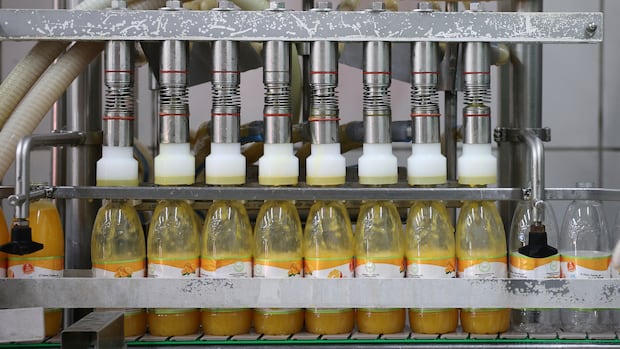
If you’ve stopped buying orange juice from Florida because the tariffs have sent prices soaring, there are many options to keep the breakfast staple on your table, says Michael von Massow of the University of Guelph.
