



Listen to this article
Estimated 4 minutes
The audio version of this article is generated by AI-based technology. Mispronunciations can occur. We are working with our partners to continually review and improve the results.
Federal officials have revealed that the total expenditures incurred during a controversial cull at an ostrich farm last year amounted to nearly $7 million.
Around 300 ostriches were culled at Universal Ostrich farm in Edgewood, B.C., last December after highly pathogenic avian flu was detected among the flock.
It happened despite dogged protests by a group of supporters and U.S. Health Secretary Robert F. Kennedy Jr.’s urging to spare the birds.
A request from Scott Anderson, the Conservative MP whose Vernon-Lake Country-Monashee riding includes Edgewood, revealed that the RCMP spent over $3.8 million in policing the operation.
Anderson requested the data from several federal institutions and the written responses were posted to the House of Commons website earlier this week.
It revealed that the Canadian Food Inspection Agency (CFIA), which ordered the cull and whose skilled marksmen eventually killed the birds, spent nearly $1.6 million on the operation.
Of that, over $166,000 was spent on disposing of the birds, and over $150,000 on cybersecurity and office security.
“[Cybersecurity] and office security costs were incurred as a result of threats to Canadian Food Inspection Agency personnel across the country, at a number of [CFIA] offices, via IT accounts and direct threats to [CFIA] employees,” reads the response.
The bulk of the RCMP’s expenditures — over $2 million — was due to personnel costs, according to the data.
Anderson, in a social media post, was critical of the costs and said the CFIA has offered little in defence of its actions other than “bland claims” that its stamping-out policy is good.
“At a cost of over $20,000 per bird … the CFIA disrupted the lives of the farmers, the entire town of Edgewood, and ultimately galvanized thousands of Canadians,” the Tory MP wrote.

The CFIA has maintained that its stamping-out policy, which mandates that flocks with avian flu are culled, is needed due to the risk of virus spread and potential mutations, which would affect Canada’s food security.
Anderson also criticized the extent of the RCMP deployment at the farm — which eventually saw two protesters arrested — and said it must have involved hundreds of officers.
“So while protesters sang around a campfire, the peace was guarded by millions of dollars worth of our national police force, which should have been out catching real crooks,” Anderson argued.

Legal costs
According to the Justice Department, the total legal costs related to the cull amounted to approximately $1.38 million.
“The services targeted here are litigation services as well as litigation support services,” the response reads.
“Department of Justice lawyers, notaries and paralegals are salaried public servants and therefore no legal fees are incurred for their services.”
Universal Ostrich’s birds became the object of international attention over the course of 2025, as the farm filed multiple court challenges to try and stop the cull following the avian flu detection in December 2024.
Ultimately, the Supreme Court of Canada refused to hear the farm’s case after previous courts ruled that the CFIA’s decision to order the cull was procedurally fair.
Earlier this month, the Agricultural Review Tribunal upheld a $10,000 fine handed to the farm for failing to report avian flu symptoms when they first appeared in the flock.
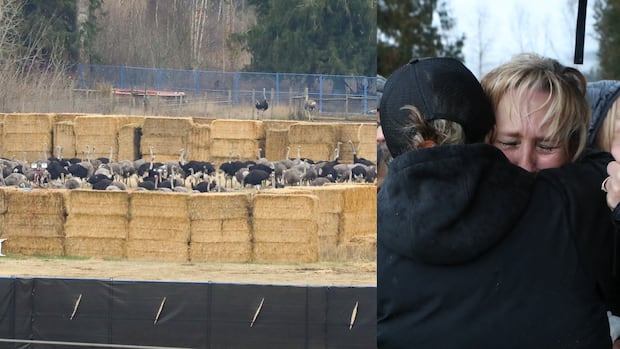
The Canadian Food Inspection Agency (CFIA) said Friday that it has culled the ostrich population on a farm in Edgewood, B.C. The cull was ordered after avian flu was detected in the flock last December and killed 70 of the birds.
