



It’s not much of a stretch to say that in terms of Canada-U.S. relations, we are — metaphorically speaking — at the point where we’d prefer to shoot the messenger, rather than listen to the message.
In the view of some experts, the political and economic discourse is so distorted, so angry, so mashed up that important points of strategic and defence policy that would have been mundane — even eye-glazing — less than a decade ago are lighting enormous rhetorical and political fires.
James Fergusson, one of Canada’s leading experts on the North American Aerospace Defence Command (NORAD) and missile defence, has watched with dismay the seemingly never-ending drama surrounding Canada’s F-35 purchase and, lately, U.S. President Donald Trump’s obsessive “need” to annex Greenland for Arctic security purposes.
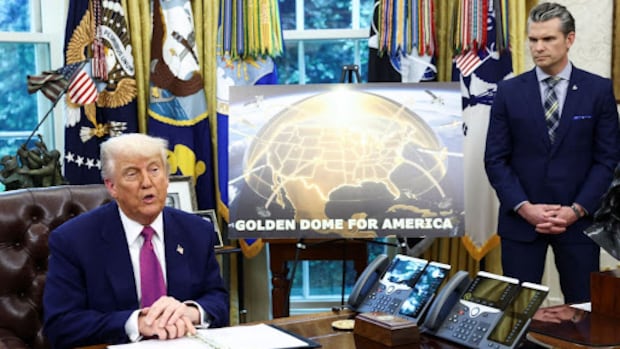
What is poorly understood and often drowned out is how those two policy issues intersect on the road to Trump’s Golden Dome missile defence plan.
The latest case in point: the reaction to U.S. Ambassador Pete Hoekstra’s comments, last week to CBC News, that, if Canada buys fewer F-35s, the U.S. will have to buy more and fly into Canadian airspace to keep NORAD propped up.
A statement from the U.S. State Department, following the publication of the interview, said his “comments were taken out of context to create headlines rather than to objectively portray his comments about the role that NORAD and the F-35 play in protecting North America.”
Trump’s ambassador to Canada is warning of defence pact consequences if Canada pulls back from its full F-35 order. ‘NORAD would have to be altered,’ U.S. Ambassador to Canada Pete Hoekstra told CBC News in an exclusive interview.
Taking aside the fact that American fighter jets routinely fly over Canada in defence of the continent, the remarks were received as just another tone deaf attempt to bully Canada into proceeding with the full F-35 order of 88 jets, which the federal government committed to more than three years ago.
Context does matter.
Had Hoekstra’s remarks not been made on the tail end of the jaw-dropping fight over Trump’s demands to annex Greenland, the deposing of Venezuela’s president and even the shootings by federal agents in Minnesota, it’s unlikely the point he was trying to make would have exploded in the same manner.
Fergusson said the debate, particularly over the F-35, is no longer being driven by sensible defence policy or even military necessity.
“It’s emotional, long-standing, but largely submerged anti-Americanism, irrational thinking, which is driven by images of Trump and beliefs about Trump, rather than a rational policy,” said Fergusson, from the Centre for Defence and Security Studies and the University of Manitoba.
“This is no way to run a national policy program with billions of dollars at stake and the defence of Canada.”
Chief political correspondent Rosemary Barton speaks with the former deputy commander of NORAD, retired lieutenant-general Christopher Coates, about U.S. President Donald Trump’s plans for a ‘Golden Dome’ missile defence system. The American Roundtable weighs in, and also discusses Trump’s latest threats against the EU and Harvard.
Similarly, the outrageous notion that the U.S. could invade, or buy, Greenland from Denmark has overshadowed the very real policy concern that Arctic island is the potential weak spot in North American air defence.
“I think the U.S., through their analysis, has perhaps arrived at the conclusion that to have an efficient, effective missile defence capability for North America, that having assets, missile defence assets, in Greenland would be a good idea,” said retired major-general Charles (Duff) Sullivan.
“I must add that the U.S. already has the ability, right now, to improve or increase or augment their military capabilities in Greenland. That agreement is already in place.”
While Trump calls it the Golden Dome, we call it — more benignly — Integrated Air and Missile Defence (IAMD).
Most people in Canada, if they’re familiar with it, remember the $61 billion US Trump wants to charge us to join.
The system is, however, a complex, yet-to-be-built web of satellites, radar stations (including over-the-horizon radar), ground and sea-based missile batteries (think Patriots and NASAMs) and fighter jets (think F-35s and F-22s).
When Hoekstra and even the commander of the Royal Canadian Air Force talk about where the F-35 fits within the air defence framework, they use empty terms like interoperability.
Most people don’t understand what that term means beyond the cursory notions that the planes can talk to each other.
Where within that puzzle a so-called fifth-generation fighter fits is rarely articulated or even discussed, Fergusson said.
What is freaking out U.S. military planners is what they see in Ukraine and Russian use of ground-hugging cruise missiles and drones, as well as hypersonic missiles.
One of the roles of a fighter jet within IAMD would be to track those missiles, chase them and destroy them before they fly over North American population centres.
That is where the debate over the capabilities of the F-35 versus the Gripen come into sharp focus.
“The F-35 is one of the capabilities that Canada has decided to procure in addition to several others that are part of an overall system of integrated air and missile defence,” Lt.-Gen. Jamie Speiser-Blanchet recently told the House of Commons defence committee.
“The F-35 is the only fifth-generation advanced technology fighter aircraft available to Canada and was selected in the competition that was conducted by the government of Canada. And it is the one at this moment that can meet all of the most advanced adversary threats that we are seeing, that are being promulgated and advanced technologically from Russia and from China.”
So, what does that mean?
Fergusson said he believes, when it comes to plugging into the integrated missile defence system, the F-35 is the best choice because of its radar, known as the AN/APG-81 Active Electronically Scanned Array (AESA).
“The F-35 will be — with its shoot-down, look-down radars — able to intercept cruise missiles,” said Fergusson.
“It has the potential, depending upon the type of air and missiles, to possibly deal with hypersonic vehicles.”

The radar built into the Gripen-E, the Raven ES-05, is smaller, draws less power and has the advantage of being able to tilt at different angles, say several technical defence industry publications.
While F-35 radar can see farther, the Gripen has a wider field of view.
It is one of the main reasons the Canadian air force gave the F-35 such high marks in its 2021 competition evaluation, giving the Lockheed Martin-built fighter an overall technical and mission performance score of 95 per cent and the Gripen-E 33 per cent. A copy of the evaluation was obtained by Radio-Canada.
In an interview with CBC News last fall, Swedish Lt.-Col. Marcus Wandt, a Gripen test pilot, insisted the Saab-manufactured jet was fully capable of plugging into the NORAD defence grid.
“The magic happens when you put all the sensors together,” Wandt said of the battlefield picture the Gripen can create.
In Sweden, “we are under threat the second we take off, and so we really had to build something that we knew would be able to fight in tomorrow’s air domain.… That’s why we built Gripen-E.”
Sullivan said he agreed with Wandt’s assessment where missile defence and the Gripen is concerned.
“There’s no reason why it would not be able to plug into the NORAD architecture in the same manner,” Sullivan said.
“We would have to ensure that our Canadian Gripen-Es would have the same encrypted, secure communication and data exchange capabilities that any aircraft — the F-35, the F-22, the F-16 — all of those aircraft are going to have to be compatible with the NORAD command and control and data-sharing architecture.”
To prove his point, Sullivan noted how last fall NORAD sent two F-35As, two older F-16s and a trio of KC-135 tankers to Pituffik Space Base in Greenland as part of a short-notice exercise.
All of the aircraft were able to operate together and defend Greenland without a lot of fuss, he said.
