



Listen to this article
Estimated 4 minutes
The audio version of this article is generated by AI-based technology. Mispronunciations can occur. We are working with our partners to continually review and improve the results.
Ryan Cutler was looking out his window from his home near Salmon Beach, on the west coast of Vancouver Island, last week when he noticed the ocean looked foamy.
Cutler quickly realized what was happening — the herring spawn was finally happening.
“It’s a really, really spectacular time to be around,” he said.
When Cutler took out his drone, he saw it — the foamy, milky blue-green water that is the telltale sign that herring are gathering to reproduce in the shallow bays along the coast.

The herring spawn is an auspicious time around Vancouver Island and the South Coast. For some coastal First Nations, it represents the coming of spring and a time to gather food.
It’s also an important time for marine conservationists to take stock of the small, oily fish that have seen their numbers dwindle due to overfishing over the last few decades.
A ‘big feast’
Herring are a keystone species that gather in large groups to reproduce.
They first lay eggs on kelp and eelgrass, and then the males release milt (sperm), which creates the milky look of the water.
Cutler says the signs of staging — when the herring start to gather and get ready to spawn — were apparent for a couple of weeks leading up to that moment.

He had seen and heard sea lions gathering, dozens of eagles flying around and even humpback whales swimming about.
“The herring spawn is a really fabulous time to be out here,” he said. “Literally all of the wildlife that we have on the West Coast shows up for this big feast.”
A turn in the seasons
Nick Chowdhury is the president of the Island Marine Aquatic Working Group, which manages a Facebook page to help people track where and when the spawn is happening.
A member of the Da’naxda’xw First Nation, Chowdhury says the spawn is an important time for coastal First Nations.
“If we focus on a First Nations perspective, it’s time for gathering food, it’s [a] signal for a lot of turn in the seasons.”

Salmon Beach was one of the first spawns spotted around Vancouver Island.
Chowdhury says part of the excitement around the herring spawn is getting to see where it’s happening each year and evaluating fish stocks.
“We have been hearing of some spawn returning to areas that it hadn’t occurred in for quite a while,” he said.
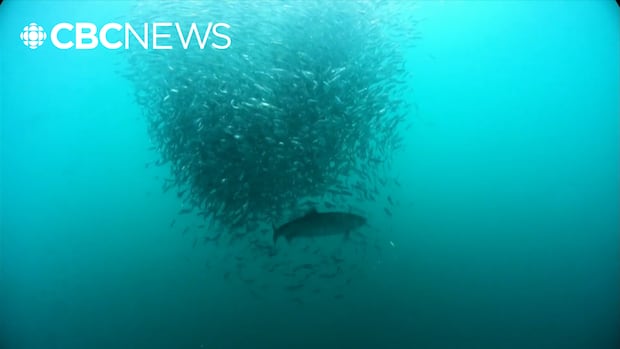
The Howe Sound Marine Stewardship Initiative and the Squamish First Nation have teamed up to study Pacific herring, a species which almost went extinct in the 1960s but has made a comeback in recent years. CBC’s Camille Vernet explains why the fish plays an important role in balancing the Pacific’s ecosystem.
Tracking when and where the spawn in happening through the Island Marine Aquatic Working Group’s Facebook page can help people understand the impact of the advocacy work that’s being put into stock management and fishing quotas, Chowdhury says.
“We have come a long way from the days of simply fishing to fish and thinking that there’s an overall endless abundance out there,” he said.
Traditional food
Long-time fisher and Stz’uminus First Nation member Shirley Louie started learning more about herring a few years ago, when the Q’ul-lhanumutsun Aquatic Resources Society (QARS) asked her to help out with a documentary project about the fish.
QARS is a group of six coast Salish First Nations dedicated to aquatic resource management, serving Cowichan Tribes, Halalt First Nation, Lyackson First Nation, Penelakut Tribe, Stz’uminus First Nation and Ts’uubaa-asatx Nation.

“They’re like, Shirley, could you find somebody to clean the fish for us?” she said.
“And so I called my aunties and my uncle and they’re like, ‘Yeah, we know how to clean herring. Do you want to smoke it or fry it?'”
Louie also learned to make and use a herring rake — a long pole with nails sticking out along the side that’s used to catch the fish.
“I love learning about it. I think it’s really valuable,” she said. “We need to get back to our smokehouses, our traditional foods.”
