



Most of humanity has a great propensity to think in the short-term, but generally, long-term considerations — air pollution, deforestation and emissions, for example — just aren’t our thing.
That’s partly why scientists are deeply concerned about a recent SpaceX proposal to launch one million satellites — data centres — into orbit around Earth.
Their concerns range from losing the natural night sky, to losing access to space, to the environmental impact on our atmosphere.
At the moment, there are roughly 16,000 satellites orbiting Earth, 14,000 of which are active. SpaceX is responsible for more than 8,000 of them.
That number changes weekly as the company both deorbits satellites — where they burn up in our atmosphere — and sends up more. On average, the company launches more than two dozen satellites twice a week.
The orbital environment
SpaceX officials have said they would like to see upwards of 40,000 of these Starlink satellites in orbit. The satellites provide internet connectivity to every part of the world, even the most remote locations.
But that’s a lot of stuff in space, and it doesn’t even account for the more than 140 million pieces of space debris ranging in size from one millimetre to 10 centimetres. All of these objects threaten astronauts who venture into space, as well as the satellites we depend on for tools like GPS.
That’s why adding another million satellites into orbit is mind-boggling.
“We saw this transition from thousands of satellites to 10,000 satellites largely done through SpaceX. And we were very worried about maintaining a healthy orbital environment with that,” said Aaron Boley, co-director at the Outer Space Institute and a professor at the University of British Columbia’s department of physics and astronomy.
“This just blows right past that. And by almost all metrics that we can think of, this is just a bad idea in terms of our long-term use and access to space.”
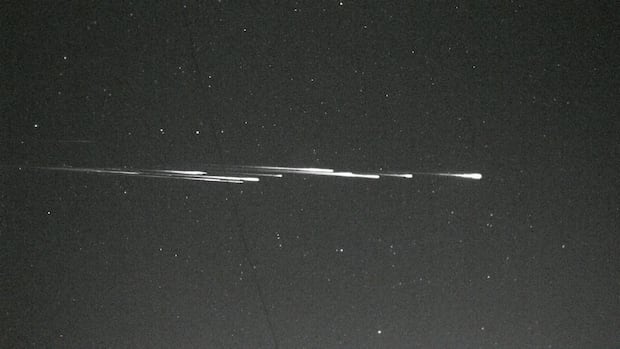
Footage from the University of Western Ontario and Defence R&D Canada shows space debris from a SpaceX Starlink satellite lighting up the night sky.
SpaceX has filed their million satellite proposal to the U.S. Federal Communications Commission (FCC), citing the need for data centres that won’t have an environmental impact here on Earth. For instance, they said the orbiting data centres would not need to use water for cooling, and noted that the sun would provide them with near constant energy.
Public comments on the plan closed on Friday. As of this writing, there were more than 1,000 comments, with the vast majority of them asking the FCC not to proceed.
Yet another threat to our atmosphere
OK, so what’s the big deal with having so many things in space? Space is big after all, right?
It’s about those long-term consequences we’re so bad at thinking about.
Scientists are concerned because mounting evidence suggests that rocket launches are affecting our atmosphere by depositing black carbon or soot into the air, which creates a potential warming effect that could increase threats to our ozone layer.
Eloise Marais, a professor of atmospheric chemistry and air quality at University College London, has been working on tracking emissions from both launches and reentries. She’s concerned that we aren’t discussing the impacts of the likely thousands of rocket launches needed to heft those car-sized satellites into space.
“And what are the additional implications of that?” she asked. “Because it really is a mix of these pollutants that impact the atmosphere.”

The key difference between these pollutants and the ones humans create at ground level is that the launches are depositing them directly into the atmosphere.
Recent studies have shown that when satellites reach the end of their lives and burn up upon reentry, they leave behind metals like aluminum and lithium.
The consequences of this are not yet known. But that’s what concerns scientists.
“It’s daunting because we’re doing this sort of experiment with the atmosphere when we don’t really know what the result will be,” Marais said.
In its FCC filings, SpaceX said it will “minimize any atmospheric impacts resulting from the deorbit of a large number of spacecraft.” No details beyond that are given, however, the company says it will move some of the data centres to a heliocentric orbit (around the sun).
That’s good, since a group of astronomers, including Dark Sky Consulting founder John Barentine, have estimated that if each of SpaceX’s million satellites were to be deorbited, it would mean one satellite reentry every three minutes.
Access to space
Most people likely don’t think about how often they use satellite communications. But that Instagram post you made? You used a satellite. Looking up directions to your friend’s party? You used a satellite. Tapping to pay for that Starbucks latte? You used a satellite.
We use satellites every day in multiple ways, and the more there are up there, the more precarious that use becomes because there’s a great risk of satellites colliding.
Satellites are also threatening how we see space. We already know that satellites are affecting professional observatories, both optically and also in terms of the electromagnetic radiation they emit. That creates noise, which can interfere with observatories that rely on radio frequencies.
SpaceX’s FCC filing claims that the satellites will be at an altitude of anywhere from 500 to 5,000 km. That would not only affect ground-based observatories, but also space-based ones like Hubble.
For amateur and casual observers, this means lights that continually cross our night sky. Look up on any night and you’re bound to see a satellite crossing at some point, even in a city. In dark-sky locations, it’s even worse, with dozens visible a night.

Astronomers warn bright light and electromagnetic radiation from thousands of Starlink satellites could be interfering with ground-based telescopes like the Vera C. Rubin Observatory, limiting our study of the universe.
“We’ve got some more detailed simulations that we’re going to include in our FCC comments that suggest there may be thousands of them illuminated at any time, visible in the night sky, that would be bright enough for people to see,” Barentine said.
This loss of the night sky, something that has guided humanity since the dawn of time and influenced culture, religion and science, would be immeasurable.
Barentine also noted that there’s a lot they don’t know, since SpaceX didn’t provide a lot of technical information in its FCC filing.
The company has been trying to work with the International Astronomical Union and its Centre for the Protection of Dark and Quiet Sky, in an effort to mitigate the brightness of its satellites, but their proposal to launch a million satellites shocked astronomers.
“I don’t think that there was necessarily something underhanded involved, but it feels like sort of an abandonment of the goodwill that we had developed with them over the last several years, to then propose something that, on its face appears to be incompatible with everything we’ve been talking to them about,” Barentine said.
SpaceX isn’t the only company proposing the launch of huge amounts of satellites.
Jonathan McDowell, an astrophysicist and space sustainability analyst who tracks every launch around the world, estimates that proposals from companies and countries (including China’s two major megaconstellation projects) amounts to 1.7 million satellites.

Now, it’s likely that many of these proposals won’t actually happen, but even just half that number would mean a lot of stuff in orbit. And that has consequences that affect everyone.
“Even when you go to dark places around Earth, far from your urban or suburban environment, the skies will not be as dark as they were. And there’s going to be no escaping that,” said Boley, the co-director at the Outer Space Institute.
“It’s really a global effect. So these launches affect everyone.”
