


Listen to this article
Estimated 4 minutes
The audio version of this article is generated by AI-based technology. Mispronunciations can occur. We are working with our partners to continually review and improve the results.
Prince Edward Island may soon be known for more than Anne of Green Gables, beaches and potatoes — a Nova Scotia-based geologist says the province is emerging as a promising new frontier for fossil discoveries.
John Calder, a geoscientist under contract with the P.E.I. government to help identify fossil finds, said the Island has begun attracting attention from researchers around the world following a surge of discoveries in recent years.
Calder said there has long been an assumption among geoscientists that fossils would be rare on P.E.I. due to its red sandstone, known in geological terms as “red beds.”
“The general thinking has always been that red beds don’t really preserve fossils well. Well, that’s not so true, not the case at all.… People didn’t look, and if you don’t go looking, you won’t find,” he told CBC’s Island Morning.
“P.E.I. is no longer considered by geologists to be a barren zone for fossils and in fact soon, with more publications and more information getting out there, it’s going to take its place along the pre-eminent sites from this geological time period in Earth’s history.”
Island Morning10:13Fossils on P.E.I.
Geologist John Calder says the Island’s sandstone isn’t just pretty to look at — fossils within it may just make P.E.I. famous for a whole new reason.
Much of the recent wave of discoveries has come not from professional scientists, but from Islanders themselves.
Calder pointed to North Rustico resident Patrick Brunet, who has uncovered many of the fossils found on P.E.I. in recent years.
“He’s an incredible sleuth when it comes to recognizing significant fossils, not just stumbling across things by chance, but becoming educated in his own right.”
Islanders will have a chance to see some of these finds up close on April 10 during Fossil Day, hosted by the P.E.I. Museum and Heritage Foundation at the Charlottetown Library Learning Centre.
Calder will also be speaking about fossil discoveries on the Island at a monthly Nature P.E.I. meeting April 7 at Beaconsfield Carriage House.
The story behind P.E.I. fossils
Though Calder is from Nova Scotia, he said P.E.I. has long been a special place for him. He explored the Island’s geological history in his 2018 book, Island at the Centre of the World.
He said the the province’s red rocks date back just under 300 million years to the Permian period — before the age of dinosaurs — a time when reptiles were beginning to diversify.
Back then, the climate was generally warm, with rivers depositing mud and sand along their banks. Those sediments would dry quickly under the sun.
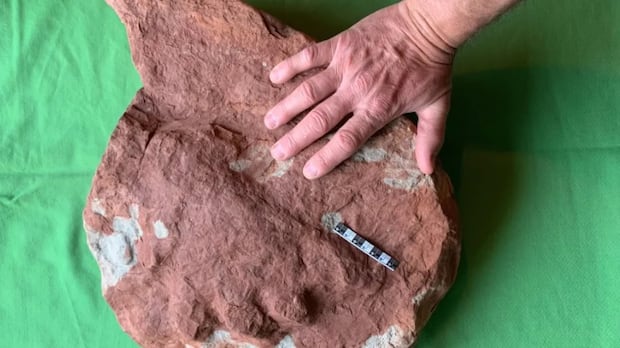
“Any animal that walked or plants that fell into it would have a very good chance of being preserved because it would dry out and harden and preserve that footprint or whatever else fell … into the muds and sands,” Calder said.
“In particular, footprints of reptiles and amphibians are gloriously preserved, but also things like insects, bones, skeletons, entire intact skeletons of reptiles.”

A farmer was digging a well in 1845 and found P.E.I.’s first fossil. We learn a little more from geologist Laura MacNeil about the creature that called the area home 300 million years ago.
Calder said his work on the Island has focused on assessing fossils found on P.E.I., which are now cared for by Parks Canada and the P.E.I. Museum and Heritage Foundation.
He has recently gone through a list of more than 100 fossils discovered by Brunet last year, most of which Calder said could form the basis of a permanent collection.
“There’s a real growing number, and hopefully one day you’ll have a museum on the Island. I mean, people are looking ahead to thinking about a day when there would be and to have a well-curated collection that represents this time period,” Calder said.
“It’s not just the people with PhDs studying this. It’s for the Islanders and the visitors to the Island to be able to come and see representations of this as well, you know, to see the collections on display and be amazed.”
