



Listen to this article
Estimated 5 minutes
The audio version of this article is generated by AI-based technology. Mispronunciations can occur. We are working with our partners to continually review and improve the results.
It’s the perfect storm of two national holidays, the biggest sports event in the world and hundreds of millions of people — all during a sweltering heat dome.
A wide swath of North America, including southern Ontario and parts of Quebec, is expected to see temperatures climb into the mid-30s and low 40s as a high-pressure system settles over many cities. Those are far from ideal conditions for a critical World Cup game. Worse, the heat is not expected to ease until the end of the week.
After a heat dome scorched Europe and was suspected to have killed at least 1,000 people within days, health experts warn there are risks here too, despite North America’s much broader access to air conditioning.
Here’s what you need to know about how to stay cool during this heat dome.

From cooling off to a ‘convection oven’
Air-conditioned environments are safest during extreme heat events, experts say. But for people who do not have access to them, fans can also help — up to a point.
“At least up until 38 degrees Celsius,” says Daniel Gagnon, a heat physiologist with the Montreal Heart Institute and Université de Montréal. “What matters is the temperature of the room that we are in currently. So, inside our home, inside our work, wherever that might be.”
He and other researchers found that around this threshold, fans helped lower body temperature slightly and, importantly, reduced the heart’s workload. The study involved older adults, including some with heart conditions.

CBC’s senior health and medical reporter Lauren Pelley ran for 20 minutes in a heat chamber set at 40 C while researchers measured the strain that the heat put on her heart, weight and core and skin temperatures. This is what the results showed.
The problem is that fans can become dangerous when indoor temperatures match or exceed body temperature.
“A fan will just create a convection oven and you’ll just heat up a lot faster, especially in older adults,” said Betsy Gideon, a postdoctoral research fellow at the UT Southwestern Medical Center.
Both experts say the fan must be pointed directly at the body to increase heat exchange between our bodies and the environment, allowing the heat to be carried away.

‘Pseudo-sweat’
Another recommendation for people without access to air conditioning is to wet their skin with water.
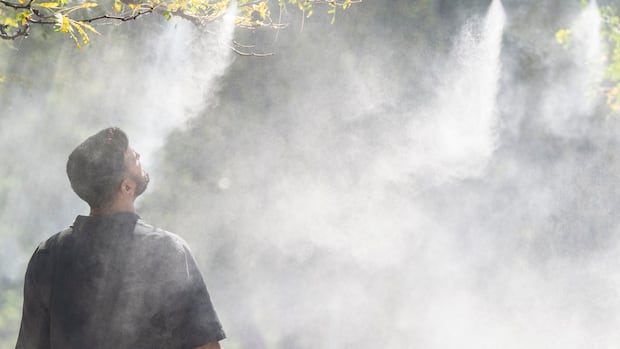
“Applying additional water to the skin kind of creates pseudo-sweat, if you will, and then allows them to have some evaporative cooling,” Gideon said. She explained this can be done with a cold shower or even a plant-misting spray bottle.
A fan, she said, can “aid in evaporation of that sweat because … it just provides more airflow.”
Gagnon said another benefit of this artificial sweat method is that it does not cost us precious resources.
“The water will evaporate and that will cool us off, just as if we were sweating, except with the benefit that we’re not losing body water,” he said.

Five years after B.C.’s deadly heat dome killed more than 600 people, dozens gathered at Vancouver City Hall Sunday to remember those lost. As the CBC’s Shaurya Kshatri reports, health authorities are warning that these extreme heat events will multiply and advocates are calling for more action to better protect communities.
Check your mood and your meds
When it comes to staying hydrated, Dr. Anna Gunz, a pediatric ICU nurse with the Children’s Hospital at the London Health Sciences Centre, said not all fluids will provide relief.
“If you’re going out and celebrating and having a beer or a drink because it’s Canada Day or whatever you’re celebrating — remember that that’s dehydrating,” Gunz said. She recommended drinking plenty of fluids with electrolytes.
Heat can also put pressure on us in different ways, Gunz said, including our mood and mental health. Children, older adults and people with psychiatric conditions are at greater risk of heat-related effects.
“The other piece that we often don’t realize is there’s a lot of medications that a lot of us are on,” Gunz said. She added that heat can change how the body reacts to those medications.
New research from non-profit group Climate Central shows that due to climate change Canadians are facing more ‘risky heat’ days, which the group’s analysis defines as when it’s hotter than 90 per cent of local temperatures between 1991 and 2020.
Long, hot nights
Another growing danger — especially as human-driven climate change adds degrees to these extreme heat events — is nighttime temperatures.
“We perhaps tend to underestimate it but I think the night part is probably the one that we need to plan the most for,” Gagnon said.
The lack of relief in temperatures from day to night, he adds, can creep up and accumulate stress in the body.
“Having cool environments of about 26 degrees or cooler is really important, we think, in terms of decreasing the risk of some of the severe health events,” Gunz told CBC News from London, Ontario.
She noted that these thresholds for fan use and heat tolerance are based on population studies and can vary from person to person.
Ultimately, experts advise planning ahead, checking in with each other and watching for signs of heat stress, including dizziness, lightheadedness and nausea.
