



Listen to this article
Estimated 5 minutes
The audio version of this article is generated by AI-based technology. Mispronunciations can occur. We are working with our partners to continually review and improve the results.
Both Canada and the U.S. have been quietly shadowing two Chinese icebreaking research ships in Arctic waters off Alaska over the last couple of weeks.
The Xue Long (Snow Dragon) and Xue Long (Snow Dragon) 2 sailed north through the U.S. exclusive economic zone in the Bering Sea in July, according to the U.S. Coast Guard.
The appearance of Chinese research ships every summer in the Arctic Ocean over the last few years has been a subject of growing concern among security and defence officials.
Data compiled by Steffan Watkins, an independent research consultant and ship tracker, shows a Royal Canadian Air Force CP-140 surveillance plane has been operating out of Alaska since early July.
The Department of National Defence confirmed Friday that the plane has been watching the activities of the two Chinese vessels in tandem with the Americans.
“The Canadian Joint Operations Command is actively monitoring maritime traffic in the Arctic, including the vessels Xue Long and Xue Long 2,” defence spokesperson Cheryl Forrest said in a written statement.
“Both vessels are currently operating outside of Canada’s exclusive economic zone,” Forrest added, referring to the area of ocean beyond territorial waters where the country has sovereign rights to resources and jurisdiction over activities like research and protection of the marine environment.
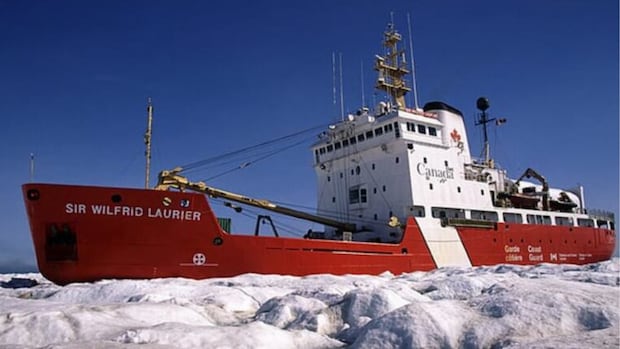
The Canadian military and possibly the Coast Guard are closely monitoring a Chinese research vessel that has breached Arctic waters for the second year in a row. CBC’s Murray Brewster says the Coast Guard was ‘following a parallel course’ of the vessel, despite denying any ‘shadowing.’
Last year, the Canadian military began a focused effort to better monitor northern waters and co-ordinate with allies in the Pacific Ocean, including the Bering Sea off Alaska, under the banner of Operation Latitude.
The Royal Canadian Navy has committed the frigate HMCS Ottawa and the Arctic offshore ships HMCS Max Bernays and HMCS Robert Hampton Gray, in addition to the air force’s surveillance aircraft.
The defence department says Canadian Special Operations Forces Command personnel and the icebreaker CCGS Des Groseilliers are also taking part.
Buoys can track submarine activity
When asked about the Chinese ships on Thursday, Defence Minister David McGuinty said the Canadian military actively monitors the country’s waters.
China, which has declared itself a near-Arctic state, has repeatedly said the deployment of its icebreakers to the region is strictly for peaceful scientific research, environmental monitoring and global climate change studies.
Both research ships, however, have been known to deploy advanced sonar and telemetry buoys. Western defence officials say these devices not only track environmental changes and undersea topography, but are also useful in tracking submarine activity.
“Those research ships could do so many different things,” said Richard Shimooka, a defence researcher at the Ottawa-based Macdonald-Laurier Institute.
There are no major international undersea fibre-optic cables in the Bering Sea region, but there is a regional subsea network vital to Alaska. Shimooka said he wonders how much time the Chinese are devoting to mapping that grid, in the same way the Russians are doing in the Baltic Sea and the North Atlantic.

Canada, Shimooka said, is playing an increasingly important role in the western Pacific at a time when the U.S. Navy is occupied with the Iran war. But, he cautioned, given the age of the Canadian navy’s frigates and coast guard ships, the country can’t do much more than it’s currently doing.
“I wouldn’t say we’re stressed, but it certainly is kind of reaching the limits that we can sustain comfortably given the age of the Halifax class,” he said.
Described as the “backbone of the Royal Canadian Navy,” the Halifax-class patrol frigates are now between 30 and 40 years old.
‘Testing our capabilities to respond’
Members of the House of Commons defence committee travelled to the Arctic in mid- to late July and Conservative defence critic James Bezan left convinced that the region needs more surveillance.
“We know we’ve had to have more assets in the Arctic to ensure that we are monitoring the movements of the People’s Republic of China as they continue to increase their interest in our Arctic,” said Bezan, who noted that China has also been increasingly co-operating and co-ordinating its air activity in the Arctic with Russia.
“They are definitely challenging and testing our capabilities to respond to these incursions.”
The federal government has begun investing heavily in the construction of new destroyers and begun the process of acquiring Arctic-capable submarines. It also plans to deploy an undersea network of sensors.
Bezan said time is of the essence because the country’s sovereignty is at stake.
“Russia and China do not recognize our maritime claims” in the Far North, including the Northwest Passage, Bezan said.
“So, we need to be investing in the Arctic. When you look at the vast amounts of resources, a high percentage of energy resources that are locked in the Arctic, including in the Beaufort Sea, we have to do more to protect it and defend against these adversaries.”
