



During the COVID-19 pandemic, B.C. Provincial Health Officer Dr. Bonnie Henry became a familiar face across the country, appearing regularly at news conferences and in media clips.
Then her face and voice started popping up somewhere else: in AI-generated videos on social media, where her likeness was used to peddle supposed health products, including a prostate treatment.
“It really scared me initially, because it was so easy for people to make it look like I was saying things that were just not true,” Henry recalled in a recent interview with CBC News.
Known as deepfakes, the online ads are “disturbing,” she added, “because you know that people are taking things that are real and distorting them.”
Henry is far from the only prominent Canadian physician whose likeness has been faked in questionable social media ads — and who has found little recourse.
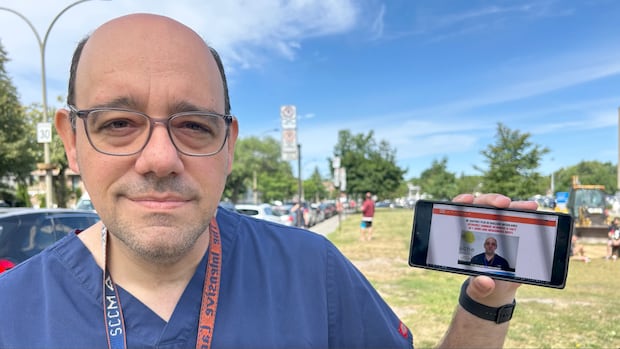
Dr. François Marquis, chief of intensive care at Maisonneuve-Rosemont Hospital in Montreal, said he’s heard from multiple patients and colleagues that videos featuring his likeness — all selling a range of pills or products — keep popping up on Facebook.
“This time I’m selling something that is supposed to fix your joints,” he said, referring to the latest AI-generated ad. “And what is getting bolder is, now I’m offering $1 million if you’re not a satisfied customer.”
Intensive care physician Dr. François Marquis discovered an AI deepfake scheme was using his face and voice to sell drugs online. Marquis is one of several Canadian physicians who’ve been the victims of similar AI deepfake campaigns.
Marquis and other physicians say these videos are scamming patients out of their money, putting Canadians’ health at risk, and eroding public trust. Yet there’s still no clear method to get deepfake videos taken down, multiple doctors agreed.
“A few years ago, when this started to happen to me, nobody had any policies, nobody knew what to do,” said Henry, who eventually filed cease and desist letters to multiple parties in hopes of combating the wave of deepfakes using her voice and face.
But she says her complaints are still hitting roadblocks today.
“I think our organizations — whether it’s police services, whether it’s universities, whether it’s employment organizations — they’re not really prepared yet to support people who are going through this,” she said.
Some well-known doctors in Quebec are warning people not to fall for a new scam circulating on social media. Videos have surfaced using AI-generated images of doctors selling health products.
Scams ‘only going to get more convincing’
The term “deepfakes” refers to a digital likeness of a real person, including their facial movements and voice, created by AI.
The videos have exploded online in recent years and the quality has dramatically improved, too, making fake videos of politicians, celebrities or physicians increasingly tough to spot.
One study found up to 50 per cent of people couldn’t distinguish deepfakes from authentic videos about scientific subjects — and that was three years ago.
“It’s only going to get more sophisticated,” warned Timothy Caulfield, a researcher and professor focusing on health law and science policy at the University of Alberta.
“These kinds of scams — and that’s really what they are — are only going to get more convincing.”
While there’s no major Canadian research yet on the prevalence of doctor deepfakes on platforms like Facebook and TikTok, a 2024 report in the British Medical Journal noted they’re increasingly common in the U.K., while American policymakers are considering a bill — dubbed the “NO FAKES Act” — to combat the growing trend of AI deepfakes in the U.S.
Canadian physicians say more research and recourse is needed here as well, alongside public education to help patients avoid getting scammed.

Canada’s new law criminalizing the distribution of AI generated nude deepfakes comes ‘too little, too late’ for one Halifax woman, whose identity is protected under a publication ban. The man who admitted to altering a photo of her with artificial intelligence was acquitted before the law was changed.
Concern over fake drugs, dangerous health advice
Marquis recalled a victim of one deepfake scam who came looking for him in the ICU, wanting his money back for pills that were never delivered.
“It was very sad, because that person invested hundreds of dollars in those pills and never received anything,” he said.
Marquis’s bigger fear is patients ordering and consuming fake drugs, or following false advice to stop their medications.
Despite those risks, he routinely struggles to get deepfake videos taken down before new ones pop back up — even though he’s flagged them to social media platforms, Quebec’s medical college and the police.
“Basically I was told that there’s nothing they can really do,” he said.

Lynn Phaneuf lost nearly $3,000 investing on a cryptocurrency site after watching a deepfake video that looked like a CBC News interview with Prime Minister Mark Carney pushing for crypto. Experts say these AI scams are becoming increasingly hard to spot.
Canada lacks ‘co-ordinated response’
As part of an effort to clamp down on deepfakes and other AI-related security issues, the federal government has in recent years taken measures such as expanding the Canadian AI Safety Institute and introducing legislation to combat non-consensual sexualized deepfakes — dubbed the Protecting Victims Act — and AI-generated electoral misinformation.
Anyone who may have been a victim of cybercrime can file a police report or contact the Canadian Anti-Fraud Centre, a federal bulletin from 2024 noted.
CBC News has contacted Science and Economic Development Canada for comment on how it is tackling medical deepfakes, specifically.
Dr. Fahad Razak, an internist at St. Michael’s Hospital and Canada Research Chair in Healthcare Data and Analytics at the University of Toronto, said there still isn’t a “co-ordinated” response to the problem across Canada.
“And what makes it very challenging is that a lot of the media we consume in Canada is not generated in Canada,” he added. “We don’t have enforcement mechanisms and the ability to save and filter out content from certain parts of the world.”

CBC’s Fact Check team has received dozens of emails flagging Facebook ads that link to deepfakes of Prime Minister Mark Carney. The fake videos are designed to scam you into sending money.
Videos selling products can be ‘red flag’
For now, much of the onus to spot and avoid deepfake scams falls on the public.
“I think that any time content is being pushed to you and they’re selling a product, that should be a major red flag,” said Caulfield.
That’s even more true for Canadian doctors supposedly selling health drugs or treatments, since provincial and territorial medical colleges enforce strict standards, noted the Canadian Medical Association (CMA) in an awareness post earlier this year.
“Although the precise rules vary, the intent is clear: doctors cannot publicly endorse health products in ads, on social media or in interviews,” the CMA stated. Those products are defined by Canada’s Food and Drugs Act as any regulated drugs, biologics, medical devices or natural health products.
Razak encouraged people to be highly skeptical of any videos featuring a doctor selling medical goods.
“If you think about your own physician experience, how often is a physician pulling out a drawer of material and trying to sell you something?” he said.
“That’s not how our health-care system works.”
