



Listen to this article
Estimated 5 minutes
The audio version of this article is generated by AI-based technology. Mispronunciations can occur. We are working with our partners to continually review and improve the results.
The federal government is expected to announce its national automotive strategy on Thursday that includes scrapping Canada’s electric vehicle mandate and replacing it with a new system of fuel efficiency standards and credits, CBC News has learned.
Prime Minister Mark Carney has been under pressure from leaders in the auto sector, multiple provinces and the Conservatives to scrap the incremental sales targets requiring 60 per cent of all new cars to be electric by 2030 and 100 per cent by 2035.
In September, Carney paused the 2026 targets and announced a 60-day review of the EV mandate, citing that the Canadian auto sector already had “enough on their plate” dealing with U.S. President Donald Trump’s tariffs.
Industry sources have been telling CBC News there have been signs the government would be getting rid of the EV mandate. Stakeholders were consulted on improving Canada’s passenger automobile and light truck greenhouse gas emission regulations. Known as tailpipe emission rules, they regulate how much pollution cars and trucks can emit.

The federal government is expected to unveil its national automotive strategy on Thursday. It will include scrapping Canada’s electric vehicle mandate and replacing it with a new system of fuel efficiency standards and credits, CBC News has learned. Greg Layson, automotive journalist, says this announcement can pressure automakers to sell greener vehicles at a lower margin of profit.
Sources told CBC News the government opted to go in that direction.
The change would be similar to one made by the European Union last year, when it unveiled a proposal to scrap its sales targets in favour of fuel efficiency standards.
Under the old EV mandate manufacturers could earn and trade credits for producing electric vehicles. A source also confirms that the system replacing the EV mandate will allow manufacturers to earn credits by producing electric vehicles, and that there will be a way to carry over credits earned under the old system to the new one.
It’s not clear when the government will put the new system in place, or if it will achieve the same emission reductions as a sales mandate.
Former environment minister Steven Guilbeault says he is open to changes to the EV mandate depending on what they are, but he doesn’t want it scrapped altogether.
“We need that mandate,” said Guilbeault. “It is essential. Not just for climate change, but in terms of air pollution, the impacts, the health benefits of doing this are very important.”
Incentives return
Sources tell CBC News some sort of incentive program for consumers buying EVs will be returning.
Canada’s rebate program for zero-emissions vehicles, known as iZEV, was suspended more than a year ago after it ran out of money due to high demand.
The government is expected to offer incentives of up to $5,000 for an EV worth $50,000 or less, Radio-Canada has learned.
Money will also be announced to build more charging stations for EVs across Canada, a source said.
Can Canada stop automakers from moving to U.S.?
Ahead of the announcement, industry and policy experts had varying reactions.
Brian Kingston, who represents North America’s big three automakers (Ford, General Motors and Stellantis) said the industry was “under enormous pressure” dealing with Washington’s tariffs.
“This makes a huge difference,” Kingston, the president and CEO of the Canadian Vehicle Manufacturers’ Association, told CBC’s Power & Politics host David Cochrane.
“This mandate was putting unnecessary and redundant costs.”
Joanna Kyriazis, the director of policy and strategy with Clean Energy Canada, has fought for the return of the electric vehicle incentives.
She is disappointed the EV mandate appears to be gone. But the clean energy think-tank has questions about what the new vehicle efficiency standards will look like and how quickly they will be implemented.
“Now that could be a transformative policy … if we get the details right,” Kyriazis said.

Canadian Vehicle Manufacturers’ Association president Brian Kingston reacts to news that the Liberals will announce a new auto strategy and the end of the electric vehicle mandate on Thursday, according to a CBC News source. Kingston argues the big Detroit automakers he represents will still have to pursue electric vehicles to meet stricter fuel efficiency standards in Canada.
Amid Canadian auto plants cutting shifts and pausing operations, Flavio Volpe, president of Automotive Parts Manufacturers’ Association, said he’ll be watching to see if Thursday’s announcement does anything to anchor operations in Canada.
Trump has been clear he wants car manufacturers to move south. Volpe wants to see if the strategy provides automakers investing in Canada more relief from American tariffs, or credit for domestic production.
“Car makers that invest here and employ Canadians should get advantages,” Volpe said.
Cabinet ministers dropping hints
Cabinet ministers this week have been hinting the auto strategy is coming but have not confirmed any details.
“It’s important because we know our autoworkers are right now feeling the brunt of the U.S. unjustified and unjustifiable tariffs,” Industry Minister Mélanie Joly said this week.
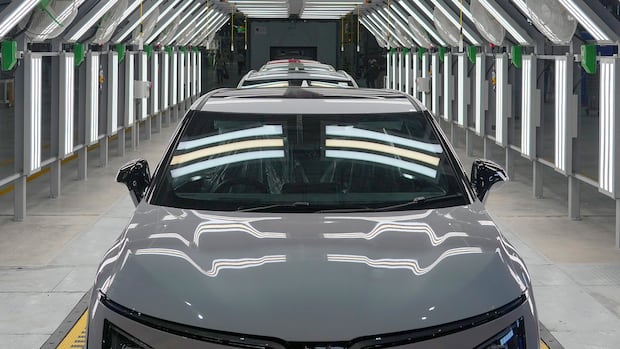
As part of a new funding strategy announced Friday, the federal government announced plans to pause the electric vehicle mandate and launch a 60-day review of the Trudeau-era policy. The prime minister said the ongoing trade war has increased pressure on the auto industry.
Asked on Wednesday if he will scrap the EV mandate, Carney did not respond as he left a caucus meeting and walked past reporters.
The EV mandate would be the latest environmental policy from the Trudeau era that Carney is dropping. He cut the consumer carbon tax on his first day in office, and has since weakened a commitment to implement an oil and gas emissions cap and abandoned Trudeau’s promise to plant two billion trees.
Guilbeault quit cabinet in November because of Carney’s memorandum of understanding with Alberta that agreed on a path forward for a new bitumen pipeline to the B.C. coast.
The agreement also suspended the Clean Electricity Regulations that Guilbeault helped implement.
