



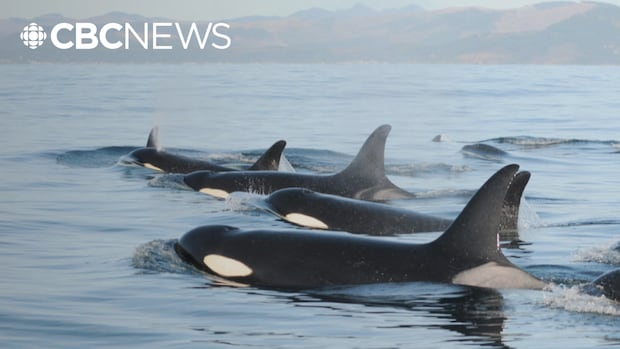
When dolphins swam onto the scene during a study on northern resident orcas off the coast of B.C., at least one researcher admitted to being a little annoyed.
The Pacific white-sided dolphins had nothing to do with the study at hand.
The research group — a collaboration between Dalhousie University, the University of British Columbia (UBC), the Leibniz Institute and the Hakai Institute — wanted to understand how northern resident orcas find food, and compare that to the struggling southern resident population.
But those seemingly annoying dolphins ended up offering an unexpected glimpse into their symbiotic foraging relationship with the orcas, according to new research published in Scientific Reports.
The researchers found the dolphins were helping the orcas hunt Chinook salmon.
Dolphins have often been considered “pesky critters” who steal fish from the orcas, according to Sarah Fortune, assistant professor of oceanography at Dalhousie University in Halifax and Canadian Wildlife Federation chair of large whale conservation.
But that’s not what was happening — on deep, deep dives below, the dolphins and orcas were communicating.

“It became really clear that the dolphins weren’t there for a free lunch,” said Fortune, the study’s lead author.
“They were actually exerting time and energy to dive deep, to chase the salmon.”
How the orca-dolphin partnership works
Andrew Trites, professor and director of the marine mammal research unit at the Institute for the Oceans and Fisheries at UBC and study co-author, said videos showed orcas following the dolphins down on dives.
“That seemed a little bit odd,” Trites said.

And recordings of the mammals’ echolocation seemed to indicate the orcas were eavesdropping on the dolphins too.
“We were noticing that the killer whale was going quiet, and it was listening to the pings from the Pacific white-sided dolphins.”
The dolphins were scouting out the salmon, Trites said.
“They were sort of spread out and pinging through the water in a much broader area than what the whales can search — and the whale was listening.”

The orcas could identify when the dolphins found a large Chinook salmon. Then they went in for the kill.
“We can hear the crunch sound as it bites down hard on the fish — literally, it’s a real crunch,” Trites said.
They were once seen by many as threatening monsters, but today are beloved. How did the perception of orcas change so much? Justin McElroy reports.
The orca shared its prey with other orcas, and in the ensuing bloody, messy feast, the dolphins fed on the scraps of flesh and tissue.
“That’s their payoff,” Trites said, noting salmon are too big for the dolphins to eat without the orcas’ help.
“Everyone’s happy at the end of a successful fishing trip, everybody gets to eat.”
Trites added the dolphins aren’t thieves stealing the fish from the orcas.
“The killer whales are so much bigger. They could take out a dolphin if they wanted to. They’re very, very tolerant of them. And so there’s absolutely no aggression.”
How the research was done
Fortune said the two-year study did its field work in summer of 2019 and 2020, working in the Johnstone Strait and Queen Charlotte Sound in Queen Charlotte Strait.
Researchers gathered underwater footage with tags suction-cupped to the orcas, Fortune said.
The tags would stay on for several hours and eventually pop off, float to the surface and emit a signal to satellites overhead.

Researchers retrieved the tag, downloaded the data and watched the “orca-eye view” on what Trites called “Orca TV.”
Drone videography shared the more traditional “bird’s-eye view.”
Keith Holmes, drone pilot, geographer and fellow researcher with Hakai Institute, first spotted the dolphin-orca interactions.

“At first you’re like, ‘Oh, get out of here. We’re trying to do some research,’” he said, wryly admitting to being “a little annoyed.”
“But then you see them doing foraging dives together, and you know, it’s really unique in the animal world,” he added.
Study shows ‘collaboration and connection’ of animals
Holmes said the hours-long dives took place over multiple days — the footage showed “all these really interesting acrobatics underwater.”
While the new videos raise many more questions, Holmes said, they also document another piece of the puzzle not often observed.
“This is just another piece of evidence of what kind of intricacies are happening out there.”

B.C. is learning more about killer whales in its coastal waters thanks to the collaborative work of hundreds of people. Citizen scientists are taking photos of whales’ dorsal fins in the Salish Sea and sending them to researchers. As Alanna Kelly reports, there’s good news about these whales, which are known to frequent B.C. waters.
The researchers recorded 258 “unique” events of dolphins travelling near the tagged orcas.
Researchers only observed the dolphin interactions in 2020.
Janie Wray, CEO and lead researcher for B.C. Whales who wasn’t involved in the research, said the study is fascinating.
“It’s a research paper that really needed to come out,” she said. “It really shows the collaboration and connection that animals have with each other in nature.”
She said it isn’t surprising that two species would help each other out with different foraging techniques.
“It’s something we’ve actually seen a lot with other species,” she said, offering the example of sea lions “hanging out” with humpback whales to snack on little bits of food leftover from the whales.
Fortune said the next steps will include examining whether certain matrilines of northern residents prefer to forage with the dolphins — and if they do, whether those matrilines are in better physical condition.
“Maybe [the dolphins are] more useful than we gave them credit for. So yeah, don’t discount a dolphin,” Fortune said.
