March 17, 2026 Team Contibutor
Nothing captures the pain of Cubans experiencing a man-made humanitarian crisis so poignantly as the words of 64-year-old Solanda Oña, who would sell books all day and then take a bus back home from Havana on better days. “Before, things were always difficult. But there was always one bus. One way to get home. Now, there are none
The script of this crisis was written the day the US cut off the island’s oil supplies after capturing the president of Venezuela. An oil blockade on Cuba and threats of US tariffs on any country supplying oil to the island have effectively halted imports since early January 2026.
Cuban President Miguel Díaz-Canel confirmed that Cuba had not received oil shipments in three months and was operating on solar power, natural gas, and thermoelectric plants.
And then came Trump’s statements, each one more extraordinary than the last. “I mean, whether I free it, take it. I think I could do anything I want with it. You want to know the truth? I think I’ll be having the honour of taking Cuba in some form,” the president told reporters at a White House signing.
The Trump administration is looking for Cuban President Miguel Díaz-Canel to relinquish power as the United States continues to negotiate with the Cuban government about the island nation’s future.
The night Cuba went dark
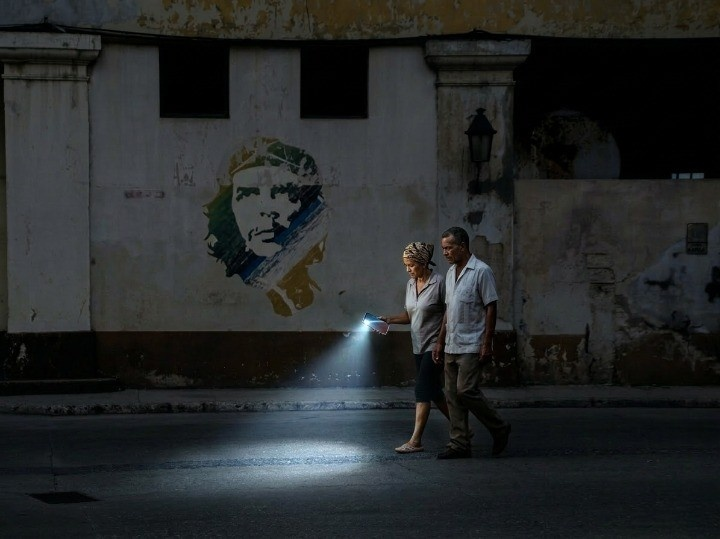
Cuba’s national power grid suffered a complete collapse on March 16, leaving nearly the entire population of 11 million in total darkness. It was the third major Cuba blackout in four months.
While authorities are attempting a phased restoration, by late evening, electricity had been restored to just five per cent of Havana — roughly 42,000 customers — as crews prioritised hospitals and key services.
William LeoGrande, a professor at American University who has tracked Cuba for years, described the country’s energy grid as “way past its normal useful life.” The thermoelectric plants have also been using heavy oil whose sulphur content is corroding the equipment.
With the island’s primary dependence on eight main thermoelectric plants, which are 40 years old, the prolonged US oil blockade on Cuba seems to be the last straw.
The human cost of the Cuba energy crisis
The impact is devastating and spreading into every corner of daily life. The Cuba healthcare crisis is under extreme duress. While the government attempts to prioritise power for major hospitals, the supply is inconsistent.
Tens of thousands of elective and non-emergency surgeries have been postponed indefinitely. With cold chains becoming silent, the stability of insulin, vaccines, and Cuba’s domestically produced biotech medicines is at serious risk.
The lack of Jet A-1 aviation fuel, the shutdown of resorts, and declining Cuba tourism collapse have taken away the very means of sustenance for many Cubans. Major carriers, including Air Canada, have suspended routes because they cannot refuel at Cuban airports.
While large resorts use backup generators, smaller casas particulares — private guesthouses — often cannot, leading to mass cancellations and a sharp drop in international arrivals. The once-bustling areas now look deserted.
Ground transport has largely ground to a halt. Nightlife has vanished. Social milestones — weddings and community festivals — are being cancelled en masse. Massive piles of refuse on street corners are a common sight.
In Havana, fuel at government-run gas stations is now highly restricted, with only tourists, diplomats, and Cubans granted a slot through an online system allowed to fill up — usually after waiting hours.
The human cost is measured in psychological exhaustion and physical hardship. Without refrigeration, families must cook and consume food immediately. Many have turned to cooking over wood fires using makeshift burners.
Anti-government protesters attacked a Communist Party office in central Cuba — a rare outburst of public dissent triggered by blackouts and deepened by the US oil blockade.
Trump’s designs on Cuba and the negotiating table
While the US has effectively cornered the island through an energy blockade, both sides have recently confirmed they are talking. On Friday, Díaz-Canel confirmed that Cuba was holding talks with the US government as the problems continue to deepen.
The stakes are high, and the rhetoric is heavy — but for 11 million Cubans sitting in the dark tonight, the only negotiation that matters is the one that turns the lights back on, both in their homes and their lives.
Related Post:
About the Author