



Listen to this article
Estimated 5 minutes
The audio version of this article is generated by AI-based technology. Mispronunciations can occur. We are working with our partners to continually review and improve the results.
The Canadian military is studying what kind of tanks and armoured troop carriers it will need in the future and how quickly those projects can and will be advanced, says the commander of the army.
An internal presentation, delivered to a closed-door audience in the United Kingdom last winter, suggested the timelines for buying new armoured fighting vehicles (AFVs) and main battle tanks (MBTs) were being accelerated.
In a recent interview with CBC News, Lt.-Gen. Mike Wright acknowledged the need to move quickly on the modernization of the army, but suggested the recent lessons and technological advances on the battlefield, particularly in Ukraine, need to be factored into future decisions on what kind of armoured vehicles and tanks are purchased.
“If you look at people, equipment, training, sustainment, we have a requirement to move as quickly as we can in all areas,” said Wright.
The internal presentation, given by the director of the Royal Canadian Armoured Corps, noted that the timeline to acquire as many as 250 new AFVs was 2035, “although we aim for as early as 2029-31.”
It also outlined how the long-established plan will see some of the army’s newer Leopard 2A6M tanks modernized and brand new ones purchased.
The army now expects to identify what kind of tanks to buy by 2030, said the presentation, obtained by CBC News.
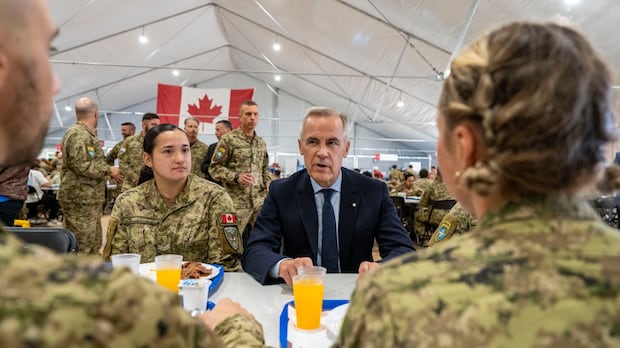
Prime Minister Mark Carney’s European trip ended after visiting Canadian troops in Latvia, where Canada leads a NATO mission. Carney announced Canada’s NATO presence in Latvia will continue through to 2029, with aims to have a full cadre of 2,200 persistently deployed there sometime in 2026. But researcher and Royal Military College professor Christian Leuprecht says this is a ‘significant challenge’ for the Canadian Armed Forces to sustain — and they don’t really have the equipment to do it.
The presentation was first reported on by the Shephard Group — a U.K.-based defence industry publication.
Wright recently delivered a speech to the University of Calgary’s Land Power Conference where he touted the upcoming reorganization of the army into divisions and the need to modernize a range of equipment. The army, he said, is working alongside the new Defence Investment Agency “to identify what other projects can be accelerated, and I have a list.”
He would not say whether the timelines for new tanks and armoured vehicles would be accelerated.
“Is heavy direct fire modernization one of my top-five priorities? No, it’s not,” Wright said, noting that the army has a total of 50 major capital projects on the go.
Among Wright’s priorities are key systems that have languished on the wish list for years — including ground-based air defence systems, long-range strike missiles, mobile artillery and Arctic all-terrain vehicles.

Like Canada, Australia is in the process of modernizing its army.
It has entered into a multibillion-dollar contract with Hanwha Aerospace of South Korea for 129 AS21 “Redback” infantry fighting vehicles. Deliveries are being accelerated and expected to be completed by 2028.
Many of the vehicles are being built in Australia — in much the same manner the Carney government would like to see defence dollars spent in Canada.
Hanwha Aerospace has informally proposed a similar deal to the Canadian government.
“I’m absolutely seeing what Hanwha has presented,” Wright said, while also remaining non-committal.
“Hanwha is amongst a number of countries who are working with Canada and offering, you know, various options to modernize all elements of the Canadian Armed Forces.”
Many of the army’s battle tanks — Leopard 2A4s — are three decades old and have in recent years suffered from an absence of spare parts because of their age. The shortage has been so acute that it has affected the brigade deployed in Latvia as part of the NATO deterrence mission in the Baltic nation.
Replacing them isn’t a question, it’s what to replace them with, Wright suggested.
“Right now, if you ask me in 2026, I can’t say what should replace the Leopard tank,” Wright said. “Do I believe that we need heavy direct fire? Absolutely. But I think by the time we will be looking at moving that project forward, we’ll have a better idea of what heavy direct-fire options exist — uncrewed and crewed — and what technology allows us to have heavy direct fire on the ground.”
The use of cheap, expendable drones to destroy Russian tanks and armoured vehicles in Ukraine has forced a fundamental reassessment of how and when armour is deployed in battle.
German and American tank-makers have redesigned their vehicles to deliver better protection for tank crews and installed anti-drone systems.
The U.S. Army will also test the Ripsaw M3 and other Robotic Combat Vehicles (RCVs) this year with plans to potentially field them by 2028. Smaller robot tanks would act as so-called battlefield wingmen to crewed tanks.
