



The rare appearance of a grey whale in the waters off Vancouver has both captivated people on social media and raised concerns, after it was struck by a Sea-Doo operator on Monday.
Fisheries and Oceans Canada (DFO) and Vancouver police are both investigating, but officials say the animal appears to be feeding and acting normally after the collision.
The incident follows a string of high-profile whale strikes last fall, an issue conservationists say is a growing problem.
Here’s what you need to know about the potential for conflict on the water.
A grey whale that had been feeding in the waters off English Bay for days was struck by a person driving a Sea-Doo Monday night. The Department of Fisheries and Oceans has launched an investigation into the incident. CBC’s Alanna Kelly spoke to witnesses about what they saw.
What are the rules?
Federal Marine Mammal Regulations require vessels to keep at least 100 metres away from all whales, dolphins and porpoises, or 200 metres if they are with a calf.
People must keep at least 400 metres away from all orcas in southern B.C. coastal waters between Campbell River and Ucluelet. And starting on June 1, people will have to keep at least 1,000 metres away from endangered southern resident killer whales in that same area.
Sensitive orca habitat is also protected by several small vessel restricted zones off the Gulf Islands.
There is no general speed limit for the waters off B.C.’s South Coast, though federal regulations require recreational boaters to keep a “safe speed” that allows them to anticipate and avoid collisions.
The Port of Vancouver does list specific speed limits of 15 knots through the First Narrows, 10 knots in Port Moody, and five knots in False Creek, Coal Harbour and Deep Cove.

How are regulations enforced?
In the waters off Vancouver, local police, port patrol and the RCMP are all responsible for general marine safety, while the port publishes a boater’s handbook with rules and regulations.
Enforcing Marine Mammal Regulations, the Species At Risk Act and the Fisheries Act falls to DFO. In B.C., that includes a whale protection unit that operates two patrol vessels out of Delta and Victoria.
The unit is charged with educating boaters about marine noise and vessel strikes, and ensuring boats don’t get too close to whales.

Fisheries and Oceans Canada’s whale protection unit cruises the waters around Vancouver to make sure people keep their distance from marine mammals.
“DFO’s enforcement program uses a wide range of tools to do this by pursuing a risk-based, intelligence-led approach,” DFO said in a statement.
“In addition to regular patrols and special operations, DFO dedicates officers to complex and large investigations.”
Violators can face charges under the Fisheries Act and be fined up to $100,000.
But Jackie Hildering, spokesperson for the Marine Education and Research Society, says there are key gaps in the regulations.
Unlike police officers ticketing a speeder, DFO officers must charge a suspect, then proceed through a lengthy court process and prove the accused’s intent to approach or disturb an animal.
She added that given the size of B.C.’s coast, enforcement remains a massive challenge.
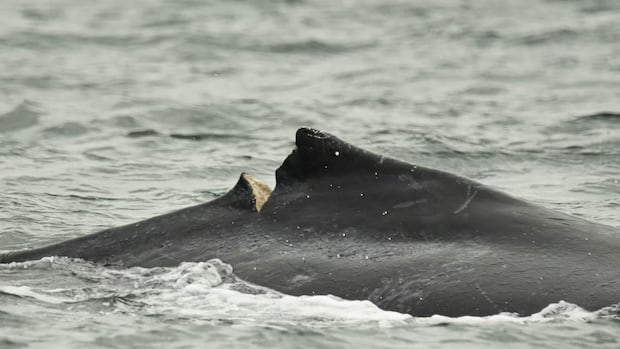
A humpback whale calf nicknamed Skipper suffered a deep gash on its dorsal fin after a collision with a high-speed ferry near Vancouver’s English Bay. The incident has some calling for boats to take more caution on the water.
What is the status of local whales?
Hildering says there are three types of whales most likely to be spotted on B.C.’s South Coast, all of them under pressure.
While the local population of humpbacks has rebounded significantly since the end of the whaling era, they’re still classified as a species “of special concern.”
Bigg’s (transient) orcas, who eat mammals, are doing better than their endangered southern resident killer whale cousins, but they remain classified as “threatened.”

According to the Center for Whale Research there are only 73 southern residents, who face threats from reduced prey (chinook salmon), marine noise and environmental contamination.
The grey whale currently sheltering near Vancouver is a rarity, according to Hildering.
She says it’s believed to be from a population that migrates to the Arctic who face a climate change-driven food shortage, and may have stopped to try and feed on its journey.
What’s the impact of ship strikes?
Documenting the actual scale of the whale strike problem remains a challenge.
DFO says it has received an annual average of nine reports of vessel strikes involving mammals across Canada over the last five years. A 2024 study published in the journal Science suggests strikes kill up to 20,000 whales globally every year, with the southwest coast of Vancouver Island a hotspot for strikes.
There have been numerous documented fatalities in B.C. in recent years, including a humpback calf struck by a Hullo Ferry last fall, and an endangered J pod orca killed in 2016.
Boat propellers can also leave whales with serious injuries.
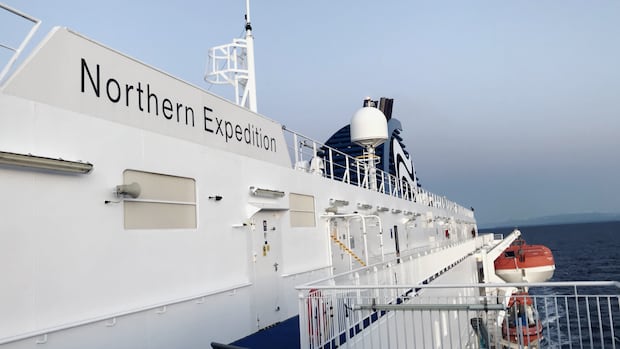
A B.C. Ferries vessel may have hit a humpback whale in northern B.C. Wednesday night. The whale was found dead by researchers in the area where the ferry reported it may have made contact.
Hildering says the known cases almost certainly underrepresent the impact.
“We will never know how many fatalities there are because so often on our vast coastline, the whales die and sink or they strand somewhere where they’re never seen,” she said.
She says the risk of collisions is also growing, both as marine traffic increases and species like humpbacks see their population grow.
How can conflict be reduced?
The Port of Vancouver sponsors the ECHO program, voluntary slow zones and alternate routes for commercial vessels transiting the Strait of Juan de Fuca. The port says 85 per cent of traffic participated last year, representing 5,300 transits.
Vancouver-based non-profit Ocean Wise has also created the Whale Report Alert System, which crowd-sources whale sightings and then pushes them out as alerts to mariners and organizations like B.C. Ferries.

A new all-electric, passenger-only ferry is charging ahead after receiving approval from the Vancouver Park Board last week. It will be operating in an area commonly frequented by humpback whales. The CBC’s Alanna Kelly has the details on what impact this could have to wildlife.
Hildering, meanwhile, believes the solution comes down to more enforcement resources and public education — especially when it comes to conflicts between recreational boaters and whales.
Because federal marine mammal regulations aren’t included in boater safety courses, the Marine Education and Research Society has created its own free Whale Safe Boating Course aimed at providing a more holistic approach.
“What we can learn from this horrible [Sea-Doo] incident is how much people care about a culture of whale safe boating,” Hildering said.
