



Listen to this article
Estimated 5 minutes
The audio version of this article is generated by AI-based technology. Mispronunciations can occur. We are working with our partners to continually review and improve the results.
It may feel like Canadians are crossing paths with bears more often than before.
In recent months, several encounters have been reported in B.C., Alberta and Saskatchewan — and some of them have turned deadly, though experts say fatal attacks remain extremely rare.
Lana Ciarniello, an independent conservation scientist and expert on human-bear conflict, said multiple factors — including wider media coverage — are contributing to the perception that bear encounters are rising.
“You’re definitely hearing about things more,” she told CBC News. “But with that said … we do believe there is an increase, as well.”
She explained that, in the case of black bears, the number of encounters can fluctuate from year to year based on food availability and the natural environment: When less food is available or when a bear’s habitat is disrupted, that can drive encounters with people.
“It’s kind of seeming like it’s [the case] this year,” Ciarniello said. “The berries, some of them are dried out in some places, and we’re having the wildfires…. That’s going to drive conflicts.”
She said communities should put more “bear-smart” measures in place, such as locking up their garbage, to avoid a dangerous run-in with a black bear.
Cross Country Checkup is asking: Have you had a close encounter with wildlife? What’s your story? Leave your comment here and our team may get in touch or read your comment on air.
Separately, when it comes to encounters with grizzly bears in backcountry areas, Ciarniello explained that other environmental and behavioural factors come into play.
Right now, for example, it’s berry season and trees are full of leaves, which can obstruct a hiker’s ability to spot a bear early along a trail.
“We try to prevent [those encounters] first from happening by making noise … letting the bear know that you’re there before you even see the bear,” she said, adding that hiking in groups and carrying bear spray will also reduce the chances of a negative encounter.
Here’s a look at some of the most recent cases of bear encounters in Canada.

After several serious bear encounters in B.C., including an attack that sent a three-year-old girl to hospital, bear safety expert Kim Titchener explains what attracts bears to residential areas, how people can reduce the risk of an encounter and what to know if they do come across one.
Grizzly seriously injures 72-year-old hiker in B.C.
A 72-year-old woman was attacked by a grizzly bear in a remote hiking area about 70 kilometres north of Pemberton, in southwestern B.C., in early August.
The woman was airlifted to hospital with a neck fracture and lacerations to her face, arms and neck, a local search-and-rescue official said.
The provincial Ministry of Environment said it believed after an initial investigation the attack was defensive, involving a female grizzly with at least one cub.
Man survives grizzly attack near Pemberton, B.C.
A man escaped serious injury after a grizzly bear attack on Aug. 9 in a backcountry area, also near Pemberton, about 30 kilometres north of Whistler in southwestern B.C.
The B.C. Conservation Officer Service said its investigation determined “the attack was defensive in nature and resulted from a close-range surprise encounter.”
The man suffered non-life-threatening injuries and was able to seek medical attention, the service said.
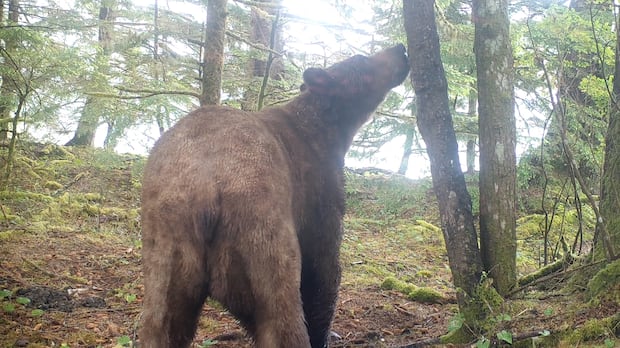
Camera traps and facial recognition software are providing a rare glimpse into individual grizzly bear behaviour in the southern B.C.’s Great Bear Rainforest. Credit: BearID Project/Nanwakolas Councilil
3-year-old B.C. girl injured playing in backyard
Earlier that same day, around 11:30 a.m. on Aug. 9, a three-year-old girl was attacked by an adult black bear while playing on her family’s backyard deck, the B.C. Conservation Officer Service reported.
“A parent who was nearby was able to intervene and chase the bear away,” it said. The service said the girl was treated in hospital for non-life-threatening injuries.
The agency said on Aug. 10 a bear that was killed in response to the incident was determined after a necropsy “to not be the offending black bear responsible” for attacking the girl.
“Efforts to locate and capture the bear responsible are continuing,” it said.
Couple killed in remote area of Saskatchewan
A couple from Regina was killed in July in a black bear attack at McTavish Lake, a fly-in lake about 90 kilometres north of La Ronge, Sask. Family members later identified them as Jay and Deb MacDonald.
The province’s Ministry of Community Safety confirmed on July 17 a bear was involved in the fatal incident but did not provide further details on what happened.
“After careful investigation, conservation officers have located and euthanized the bear suspected to be involved in the incident,” the department said, adding the case remained under investigation.

Wildlife officials have euthanized a black bear suspected in the deadly attack on a Regina couple in remote northern Saskatchewan on Wednesday. The bodies of Jay and Deb MacDonald were found near their cabin at McTavish Lake.
Attack in northern Saskatchewan kills 27-year-old
A man working at a uranium exploration project site in northeastern Saskatchewan’s Athabasca Basin was killed in a black bear attack in May.
The man was later identified as Hrishikesh Koloth, a 27-year-old from India.
