


Listen to this article
Estimated 5 minutes
The audio version of this article is generated by AI-based technology. Mispronunciations can occur. We are working with our partners to continually review and improve the results.
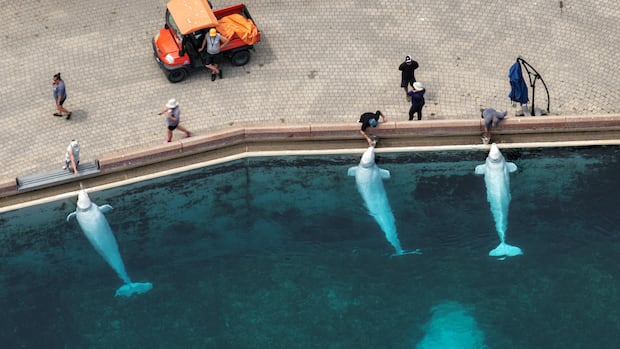
Earlier this month, the federal government approved a plan that could send the 30 beluga whales at the shut-down Marineland in Niagara Falls, Ont., on an international journey to their new homes.
The belugas can’t go to another aquarium in Canada because a 2019 law bans keeping whales, dolphins and porpoises for breeding or entertainment. Instead, the whales are expected to be split up between an aquarium in Spain and four in the United States.
So, how to transport an aquatic animal that can grow up to 4.5 metres or more, and weigh up to 1,900 kilograms?
While we don’t have all the details yet from the destination aquariums who are overseeing the rescue plan, we spoke to experts who are familiar with the hefty task of whale transport.
Here’s a step-by-step guide.

The 30 remaining beluga whales at Ontario’s defunct Marineland theme park are one step closer to having new homes. Fisheries and Oceans Canada endorsed a rescue plan that would send the animals to four aquariums in the U.S. and one in Spain.
Step 1: The paperwork and preparation
Belugas don’t need passports. However, their team would need permits from the Canadian government and the recipient countries to move them, according to Andrew Trites, the director of the Marine Mammal Research Unit at the University of British Columbia.
Someone will have to decide where each animal is heading, which could be influenced by what the trainers know about their personalities, he said. And, the belugas would have to get a veterinarian’s assessment, bloodwork and other health checks done before they travel, he said.
While Ottawa has given its approval, more “logistical steps and permits” are needed before the whales can be moved, according to Johnny Ford, the vice-president of communications at potential destination Shedd Aquarium, in an email statement.
“Rescue details are expected to continue to change based on the individual needs of the whales,” Ford wrote on behalf of the potential recipient aquariums.
Step 2: Practice, practice, practice
Trainers would generally spend months ensuring the belugas are used to the tools that will move them from their tank, according to Rob Lott, who is based in Chippenham, U.K., and the captivity lead of the wildlife charity Whale and Dolphin Conservation. His team was a founding partner of a beluga sanctuary in Iceland, to which two belugas were transported from China in 2019.
The belugas would be lifted from their tank with a custom-made sling and stretcher. Before travel day, trainers would put it into the tank, encourage the belugas to check it out and then reward them when they swim into it, Lott said.
It depends on the whale’s personality, but it can take a couple of months for them to get comfortable with the sling, he said.
Step 3: Lifting belugas out of the tank
On travel day, the slings would lift the belugas out of the tank and into a custom transport crate, where they are suspended on a stretcher.
The crate would need to be large enough for the animals to move their heads and tails, Lott said. It would be filled with enough water to submerge the belugas, but not so much that it sloshes around.
The crate is expected to be padded to reduce external noise that could stress out the whales, Trites said.
Step 3: Welcome aboard
The transport crate is expected to be moved by truck to a cargo plane and a crew of trainers and veterinarians travel with the belugas. The animals’ breathing would likely be monitored throughout the flight to ensure they are comfortable, Trites said.
“I can well imagine they’re going to get the occasional reassuring touch, almost like you hold your partner’s hand at takeoff,” he said.
The pilots may also fly as low as they are allowed, Lott said.
“The highest altitude belugas normally encounter in the wild is at sea level … so that was something else that would aid their safety and comfort in the air,” he said.
Step 4: Arriving at the destination

Upon arrival, the transport crates are expected to be once again placed on a truck to drive the belugas to their new homes.
The animals would be quarantined to ensure they are still healthy and not carrying any communicable diseases, Trites said. Some trainers would likely also stay to pass along their knowledge of the whales’ quirks to the new trainers.
Why not release the belugas into the ocean?
It’s geopolitically difficult to return many belugas to their native waters, because many come from Russia, Lott said.
Sending the Marineland belugas into the wild would have been “inhumane,” Trites said. At least half of the animals were born into captivity, so they don’t know how to hunt and wouldn’t be accepted by the local beluga population.
“The animals are so social that they can’t survive on their own,” he said.
