



Listen to this article
Estimated 5 minutes
The audio version of this article is generated by AI-based technology. Mispronunciations can occur. We are working with our partners to continually review and improve the results.
Ontario’s medical regulator is proposing sweeping changes to prescribing safer supply drugs, The Canadian Press has learned.
The College of Physicians and Surgeons of Ontario is looking to clamp down on the practice and is set to hold a board of directors meeting next week to decide on the proposed changes.
Safer supply refers to prescribing medications as an alternative to opioids obtained on the streets to those who are at high risk of overdose.
The most common form of safer supply is hydromorphone, a powerful opioid often prescribed for pain but significantly less potent than fentanyl and its derivatives that dominate the illicit drug supply chain. Fentanyl is often found laced with other drugs such as benzodiazepines, a depressant, and xylazine, often used to tranquilize animals.
One change the regulator has proposed in a document tucked away on its website is that “physicians must only prescribe safer supply medications in conjunction with opioid agonist therapy.” The therapy uses medications such as methadone to treat opioid addiction.
The college is also proposing an eight-week time limit for physicians to prescribe safer supply, and mandating that it be consumed in front of health-care professionals.
The regulator previously made changes to its drug prescription policy in May that mandated physicians to perform an in-person assessment before prescribing narcotics for safer supply, as well as making it mandatory for doctors to offer opioid agonist therapy before prescribing safer supply drugs and perform follow-ups every three months.
The rationale behind the new proposed changes centres largely on diversion of patients’ prescription pills to the black market.
“The proposed amendments build on targeted changes introduced in May and respond to ongoing concerns about the diversion of safer supply medication and the resulting risks to patients and communities,” Mickey Cirak, spokesperson for the College of Physicians and Surgeons of Ontario, wrote in an email.
“In response, the college has proposed amendments intended to strengthen oversight of safer supply prescribing and enhance safeguards related to physician prescribing practices, consistent with its role as Ontario’s medical regulator.”

Canada’s opioid crisis has led to the deaths of tens of thousands of people, costing the health and justice systems billions. Many health providers say there were solutions that could have helped. We reveal how politics got in the way.
Health minister supports changes
The college said it has consulted with a broad range of people and organizations, including physicians, municipalities and health-care partners, as well as the office of Ontario’s chief medical officer of health, Dr. Kieran Moore.
Moore’s office did not respond to a request for comment or an interview. Moore has never granted The Canadian Press an interview about the province’s opioids crisis, despite more than a dozen requests since he took the role in 2021.
The College of Physicians and Surgeons said the initiative to change safer-supply prescription rules is its own and did not come from the provincial government.

Two supervised drug consumption sites in Moss Park received letters on Friday from the Ontario Ministry of Health saying that their provincial funding will end in 90 days. CBC’s Ali Chiasson spoke to advocates who are concerned this could lead to more open drug use in the area.
Cirak said the college also received feedback from doctors with expertise in addiction medicine.
The proposal has the support of Health Minister Sylvia Jones.
“Our government does not and will never support the distribution of illegal drugs, including the illicit use of hydromorphone masked as ‘safer supply,'” said Satnam Grewal, a spokesperson for Jones.
“We welcome any action from Ontario’s 27 regulatory colleges who set standards and obligations for health-care professionals, including the College of Physicians and Surgeons of Ontario, to crack down on the predatory prescribing of addictive drugs.”
Changes ‘dangerous’: harm reduction worker
Ontario has moved to an abstinence-based model under Premier Doug Ford in its approach to the ongoing opioid crisis. The province closed provincially funded supervised consumption sites and passed a law banning them within 200 metres of schools and daycares.
The province has since opened 29 homelessness and addiction recovery treatment hubs, which the government calls HART hubs. It has spent more than $500 million on that plan, which offers primary and mental health care, addiction services and peer supports.
Word of the proposed changes has reached some people who depend on safer supply, said Lorraine Lam, an organizer with the Shelter and Housing Justice Network and a longtime harm reduction worker.
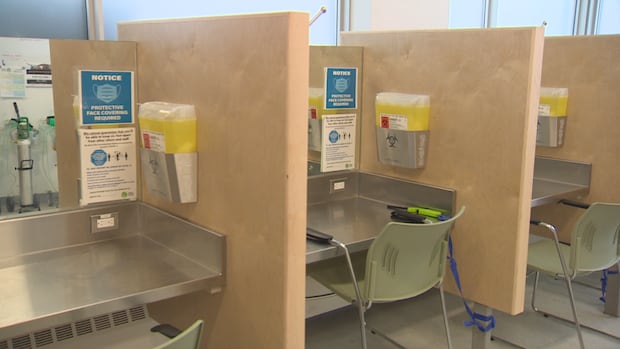
After passing a law closing numerous supervised consumption sites, the province opened nine of its HART hubs on Tuesday. But critics say Ontario’s new approach is off to a bumpy start. Shawn Jeffords explains.
“The changes are really dangerous and very destabilizing,” Lam said.
“People are really, really scared and people are really, really anxious and very angry.”
She said some people using safer supply got jobs or returned to school and she’s worried what will happen to them when they’re cut off.
“The reality is people who are on safe supply are going to be de-prescribed really, really quickly, which will increase the chances of people turning to the street unregulated supply, which will then therefore increase the risk of overdoses and deaths,” Lam said.
The college’s board of directors is set to meet on Oct. 13, when it is expected to vote on the proposed changes.
